

What is BuzzFarmsAI?
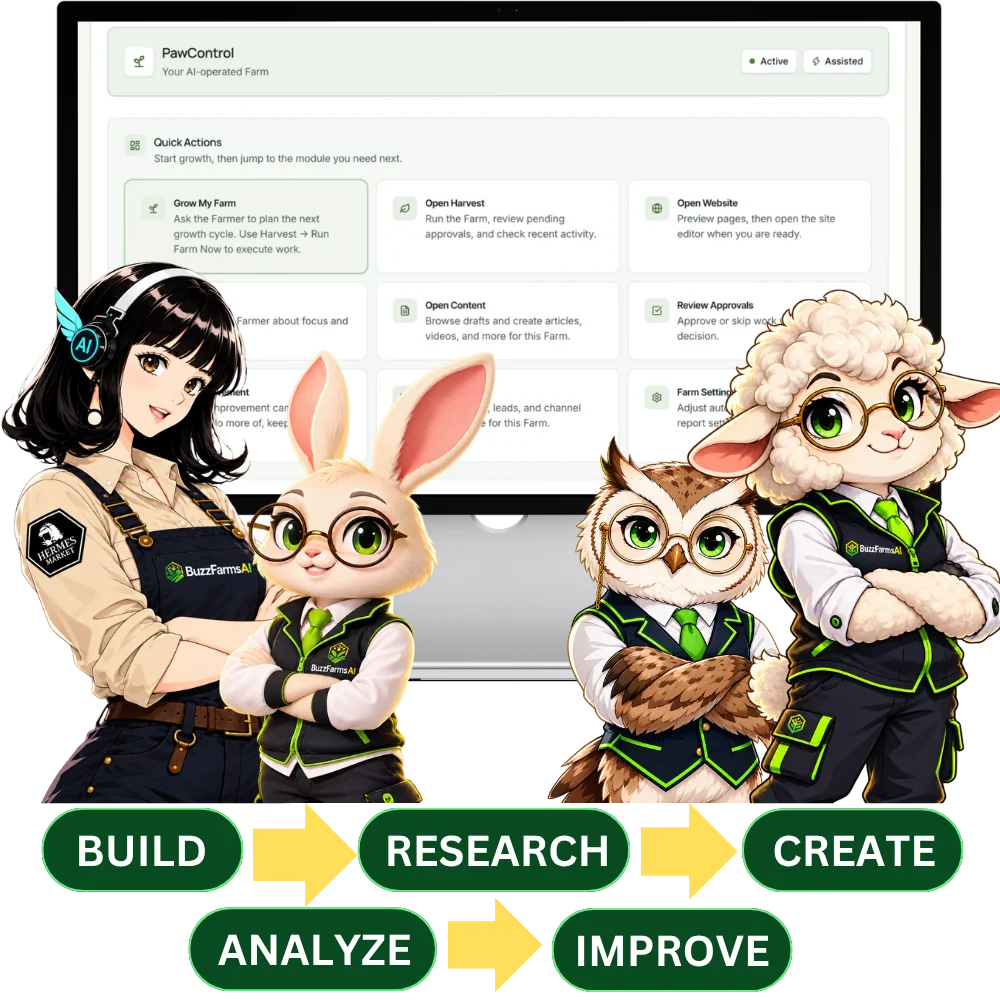
BuzzFarmsAI is presented as an AI-coordinated website and marketing platform. Its properties are called Farms. A Farmer Agent coordinates specialist Farm Hands for site building, content, audience opportunities, distribution and analysis, with shared project context intended to keep the work connected.
The official overview describes single-offer, comparison, multi-product, local-service and media properties, plus content around courses and information products. The model is broader than generating one article or page: the property is a base for a continuing marketing workflow.
To choose the structure around the visitor's decision, use the Farm-type selection guide.
For the coordinator, workers and persistent context, read the Farmer Agent explanation.
Who should consider it?
BuzzFarmsAI is a plausible fit for someone maintaining a focused product resource, developing an educational property or organizing marketing work for a small business. Its practical appeal is reducing disconnected handoffs, while keeping an audience and business goal visible.
Service providers should define the deliverable before promising a maintained Farm to a client. Beginners can start with a small brief and approved source material, but still need to review facts and understand the next action. Skip the idea of an unattended business that guarantees buyers, rankings or recurring income.
For accurate service details and enquiry handoff, follow the local client-site workflow.
Before agreeing what a client receives, check commercial-use and client-work boundaries.
How the workflow fits together
The Lite description begins with an offer and prepares an opt-in page, matching giveaway and promotion. Advanced describes a broader property. These are advertised workflow scopes, not confirmed price tiers or proof that every offer includes both.
| Stage | Intended work | Useful review |
|---|---|---|
| Brief | Define the audience, offer and goal | Is the assignment specific? |
| Build | Organize the property and initial material | Does it answer the reader's need? |
| Research | Find topics and audience opportunities | Are the sources relevant? |
| Distribute | Prepare or perform authorized publishing | Are the content and destination approved? |
| Review | Use Harvest signals for the next decision | What does the evidence actually support? |
For the sequence in more detail, explore the full Farm workflow.
For a bounded starting brief, use the guide to planning a first campaign.
To compare the scope of those workflows, read Lite versus Advanced.
Features with a practical purpose
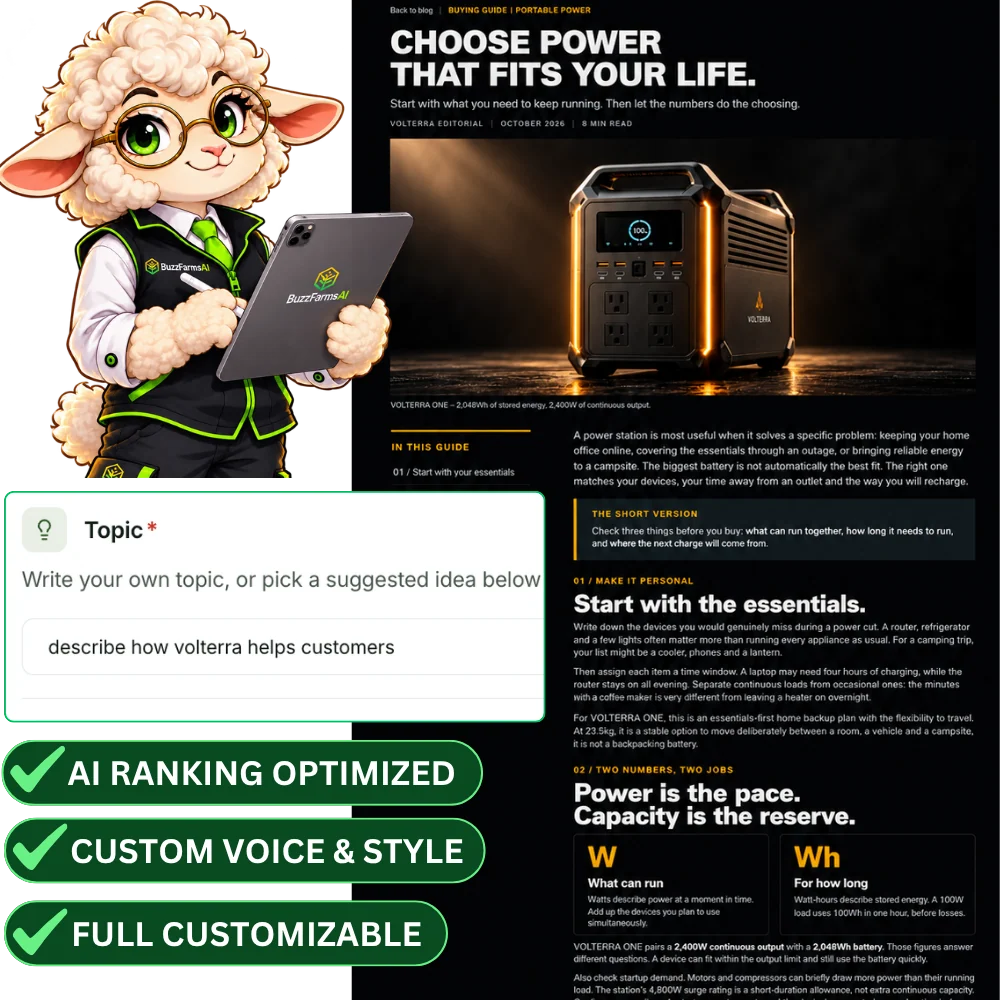
The official description includes articles, comparisons, videos, PDFs, opt-in resources and promotional material. The strongest use is giving each asset a job within the same reader journey. A buyer guide should help decide; a tutorial should help complete a task; a giveaway should deliver its stated value.
Opportunity research is intended to find relevant questions and conversations rather than rely only on publishing more pages. Discovery is useful context, not permission to post in every community or proof that an audience will visit. Good distribution starts with useful material and an appropriate destination.
Before publishing generated material, apply content quality and SEO checks.
To distinguish research from authorized participation, see traffic discovery and distribution planning.
For a relevant intermediate step in the reader journey, use the opt-in and lead-magnet guide.
Control, context and measurement
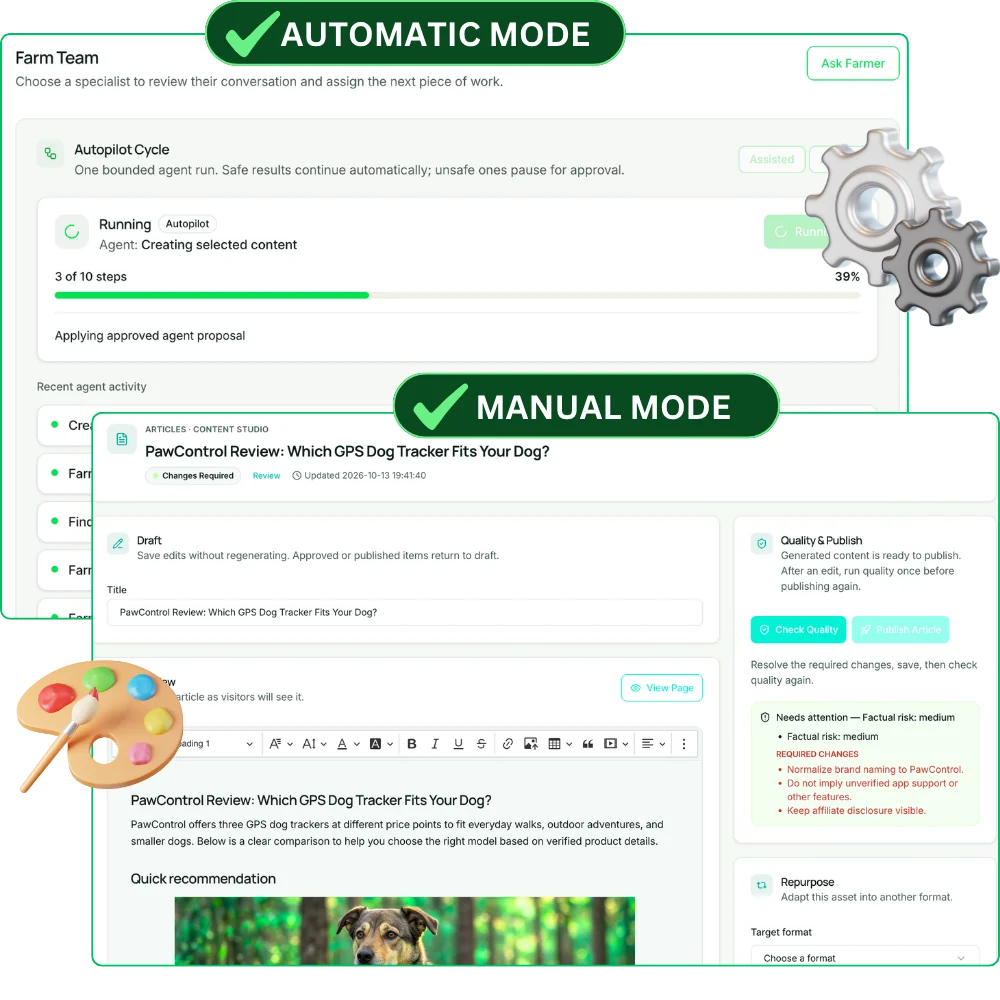
BuzzFarmsAI describes Assisted Mode, an Approval Center and persistent Farm memory. The intended benefit is continuity with oversight: workers can use the project context while important actions return for review. Memory is not proof of model training, and an approval label is not a security certification.
The Harvest description includes visitors, leads, promotional clicks and enquiries. Sales and commissions are conditional on supported integrations. A click is not a completed order, and a reported transaction does not automatically establish complete attribution. Confirm the actual connection and its reporting boundaries.
Before connecting accounts or authorizing public actions, work through permissions and approval planning.
To interpret activity without overstating results, consult the Harvest metrics dictionary.
Advantages and tradeoffs
The positive case is workflow coherence, not a promise that all marketing work disappears. These are the practical strengths and tradeoffs that matter when deciding whether the approach fits.
| Practical strength | Tradeoff to consider |
|---|---|
| One stated Farm goal connects multiple tasks | A weak brief can carry the same mistake between workers |
| Different property models support different reader journeys | Templates do not replace useful original content |
| An assisted workflow keeps review in the process | The publisher still needs time to inspect important actions |
| Harvest focuses attention on meaningful activity | Interpretation and transaction attribution depend on actual evidence |
Pricing and availability
The background offer table advertises a $37 Premium entry purchase. That is an advertised figure, not a verified current checkout total. Other seller pages contain conflicting plan prices and upgrade descriptions, so we do not select an attractive number or assume a bundle includes every feature.
Our November 1 source check did not reach a verified BuzzFarmsAI order form through the configured offer route. Final billing, allowances, model costs, hosting dependencies and refund terms remain offer-specific questions. No accepted coupon is verified here.
For the advertised numbers, conflicts and terms to confirm, read the detailed pricing and package guide.
Evidence and customer feedback
Our Tried & liked verdict is qualitative publisher feedback. It does not establish a testing duration, coverage of every upgrade, a traffic improvement or a customer earnings result. The separate feature explanation is grounded in the seller's published description.
Some testimonial text on the public preview names other products. It cannot establish BuzzFarmsAI customer consensus. We have not invented a complaint count, satisfaction percentage or aggregate rating to fill that gap.
For identity, source quality and the genuine offer route, use product evidence and buying checks.
An integrated Farm or DIY tools?
The Farm approach is most interesting when coordination is the missing piece. A separate site builder, content tool, scheduler and reporting setup can also make sense, particularly when an existing process already works. The difference is who maintains the connections and carries the brief between them.
Compare the specific work you need, the actual supported connections and ongoing responsibilities. There is no evidence for declaring BuzzFarmsAI universally better than every specialist tool.
For a responsibility-based decision framework, read the integrated-versus-DIY comparison.
Our verdict: Tried & liked
BuzzFarmsAI is worth considering if you want a more organized way to connect a marketing property, useful content, audience research and reviewed next actions. We liked using it, and the connected workflow is a compelling direction for a focused publisher or service provider.
Choose it around one realistic project and verified offer terms. Keep source accuracy, permissions and the reader's needs central. The strongest reason to consider it is a workflow you can understand and supervise—not an income headline or an assumption that more automated output must produce better results.
Questions answered
What is BuzzFarmsAI?
It is described as an agent-coordinated platform for marketing properties called Farms, connecting site creation, content, opportunity research, distribution and analysis.
How much does BuzzFarmsAI cost?
The background offer table advertises Premium at $37, but conflicting materials and the unverified checkout route prevent treating that as a confirmed current charge.
Is there a verified money-back guarantee?
Current seller material contains conflicting refund periods. Obtain the final product-specific terms for the offer before relying on a particular guarantee.
Is BuzzFarmsAI suitable for beginners?
A small, well-defined campaign can be a sensible starting point. Beginners still need to review sources, content and publishing decisions rather than assume the agents remove those responsibilities.
Can I create Farms for clients?
The seller describes commercial client work. Exact client-account, transfer, resale and white-label rights need confirmation in the applicable licence; they are not interchangeable.
Does BuzzFarmsAI guarantee traffic, sales or search rankings?
No. A coordinated workflow can support the work, but content quality, demand, distribution, execution and supported measurement determine what can actually be observed.
Explore the offer
If the connected Farm approach fits your project, inspect the product-specific offer and package details.
View the offerSources and scope
Product descriptions are attributed to the seller; planning examples are editorial guidance, not measured outcomes.