
Give the Farm a real goal
The advertised starting inputs include URLs, files, product details and a description of the audience or business goal. These become the context for the property. A goal such as helping homeowners understand a genuine service is more actionable than a vague instruction to build a profitable site.
The seller describes several Farm models, including single-offer, comparison, multi-product, local-service and media properties. The model should follow the visitor’s task. A comparison property needs comparable alternatives and buying criteria; a local-service property needs accurate service information and a clear enquiry route. Neither starts with an arbitrary target for the number of pages.
To match the site model to the audience’s task, use the Farm-type guide.
Coordinate specialist workers
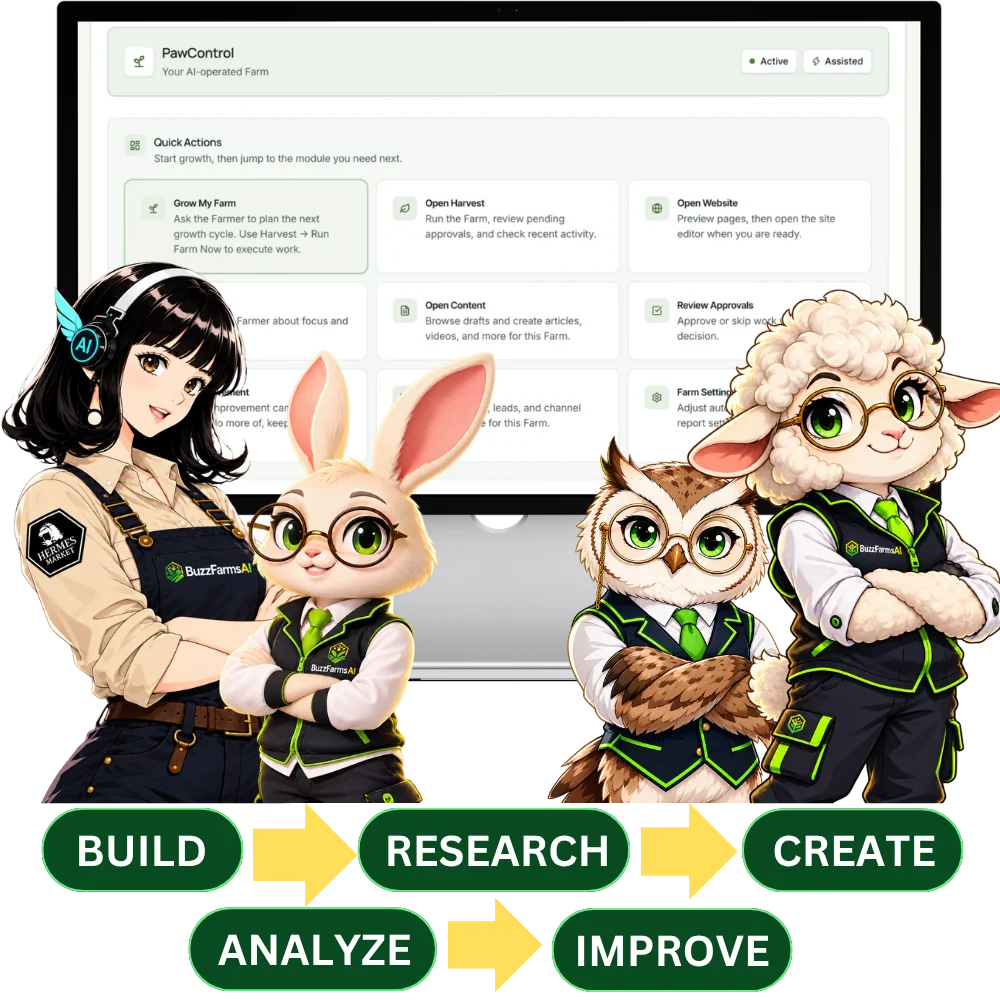
BuzzFarmsAI’s Farmer Agent is described as coordinating specialist Farm Hands for site creation, content, traffic-opportunity research, distribution and analytics. Instead of treating every request as an isolated chat, the advertised system organizes these roles around the same property and goal.
That coordination is meaningful when the work has dependencies. Research should inform the draft; the draft should support the offer; the distribution material should reflect the approved content. The software’s agent vocabulary does not remove the need to verify sources or decide who can approve an external action. Coordination and correctness are different properties.
Create a connected property
The seller describes site templates, editing and content formats including articles, comparisons, videos, PDFs and lead magnets. The Lite path focuses on an opt-in page, matching giveaway and promotional campaign. The Advanced path is presented as a broader Farm with supporting pages and ongoing activity.
A useful property connects the visitor’s question to a relevant next step. For example, an illustrative comparison guide might help a reader identify a suitable option, then offer a checklist for evaluating it. This is a content-planning example, not a record of a generated site or a measured conversion. Pages still need accurate facts, understandable navigation and an honest offer.
Review distribution opportunities
The opportunity-research description includes questions, discussions, communities and other places where the intended audience is active. Distribution is described differently for owned properties and third-party spaces: the platform can prepare material for review rather than treating every discovered conversation as permission to post.
This distinction is essential. Relevance does not override a community’s rules, account permissions or a person’s privacy. An appropriate contribution should answer the question and stand on its own. Assisted Mode and the Approval Center are advertised control points; confirm their actual scopes before allowing recurring or more autonomous work.
- Check whether the source and audience fit the Farm’s purpose.
- Confirm what action is proposed and which account would perform it.
- Review facts, wording, disclosures and platform rules before release.
- Keep approval separate from discovering an opportunity.
For practical boundaries around account actions and publishing, read the Approval Center guide.
Use signals to choose the next task
The Harvest dashboard is described around visitors, clicks, leads and enquiries, with sales or commissions where supported integrations provide them. An Analyst can feed those signals back to the Farmer to propose another content or improvement cycle. A click remains a click unless a reliable transaction signal connects it to a sale.
Persistent memory is described as retaining the Farm’s offer, audience, instructions and previous activity. That can provide continuity, but it is not evidence of independent model training or guaranteed improvement. Review the proposed next task against the evidence, available budget and your actual business goal. More output is not automatically better output.
For the overall recommendation and buying considerations, return to our main BuzzFarmsAI assessment.
Questions answered
Does BuzzFarmsAI just build websites?
Its advertised workflow also covers content, opportunity discovery, distribution and analytics feedback. The exact included capabilities and limits still depend on the selected offer.
Does a Farm publish everywhere automatically?
Do not assume so. Owned publishing and third-party actions have different permissions, and prepared posts or replies may need review and approval.
What does self-improvement mean here?
The seller describes using remembered context and performance signals to guide later activity. That is not proof of model training, automatic ranking improvements or revenue growth.
Keep the full picture
Connect this guide with the main review before choosing your workflow or package.
Read the main reviewSources and scope
Product descriptions are attributed to the seller; planning examples are editorial guidance, not measured outcomes.