
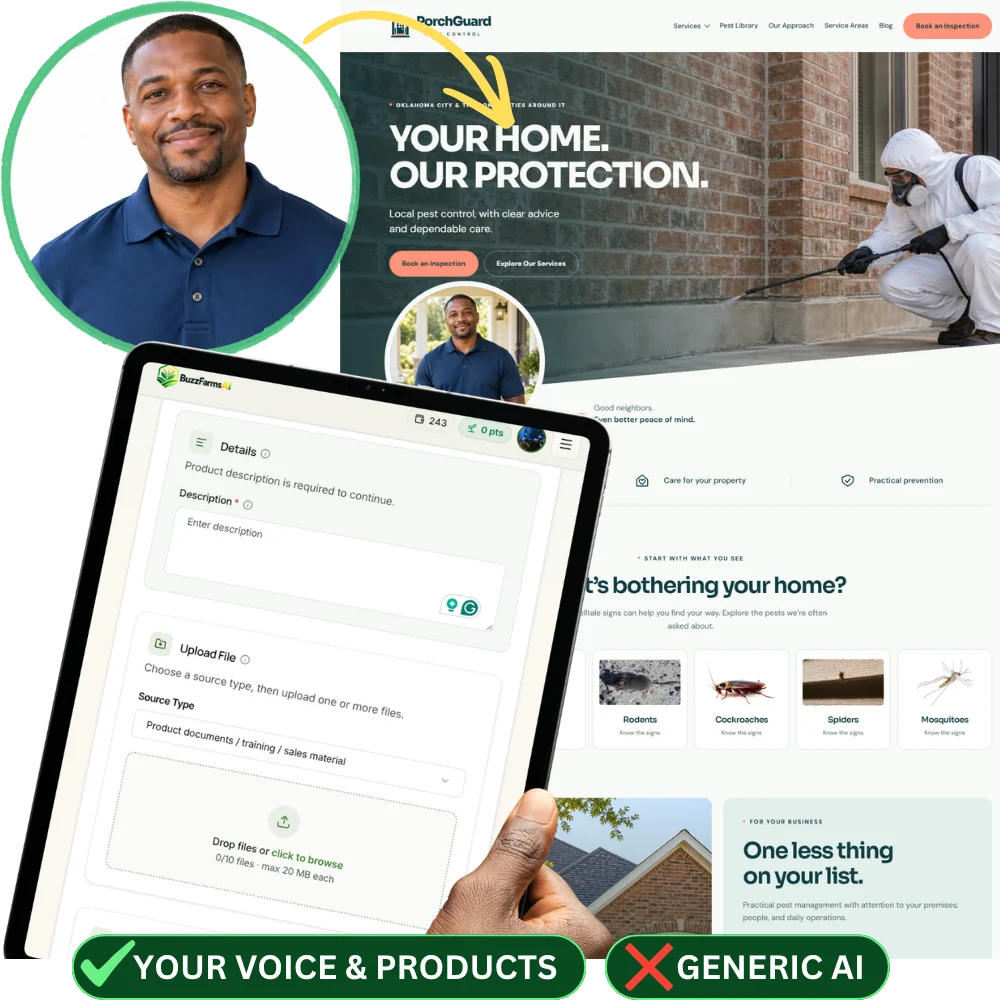
Choose a bounded first brief
Choose an offer or service you understand. Gather its current facts, approved images, relevant URLs and limitations. Decide which audience question the campaign will answer before choosing the page type. One coherent project is easier to review than several unrelated properties.
The documented workflow accepts URLs, files and product details. That is not permission to upload confidential client material or personal records. Supply only authorized information, remove unnecessary sensitive data and list the claims requiring a current source check.
If you are still deciding whether this workflow fits your work, start with the complete BuzzFarmsAI review.
Write the intended outcome
An illustrative brief could request a home-maintenance checklist for homeowners in an authorized client’s actual service area. Its next step might be requesting information, not purchasing. This planning example does not represent a customer, generated result or verified leads.
A brief works best when it names the audience, problem, evidence, output and boundaries. State what must not be invented: service coverage, prices, reviews, certifications or results. Define who reviews the work and what requires approval. These instructions make evaluation possible even when the generated draft appears fluent.
| Brief field | What to supply |
|---|---|
| Audience | Who needs the information and what decision they face |
| Offer | The actual product or service, with source-backed details |
| Output | A bounded page, guide or campaign deliverable |
| Visitor action | One clear, appropriate next step |
| Approval | Who checks content and authorizes external actions |
Match the workflow to the job
The Lite description centers on a hosted opt-in page, matching giveaway, promotional material and campaign flow. The Advanced description centers on a broader Farm property. Choose the scope because of the job, not because the larger option sounds more powerful. A quick campaign does not need every possible site format.
Confirm that the selected offer includes the mode and resources you intend to use. Before authorizing generation, understand the applicable allowances, connected-service costs and revision process. The documentation does not justify inventing a credit amount or a universal button sequence for all accounts and versions.
Review the visitor journey
Read the page and any matching guide as a visitor would. Does the opening answer the promised question? Are product facts supported? Does the next step match the offer? Check that a giveaway is genuinely useful rather than an unrelated document attached to a form. Inspect mobile readability, image descriptions and link destinations.
Then review the proposed distribution separately. A draft suitable for your own site may be inappropriate for a community thread. Confirm the account, destination, permission and exact content before approving an action. Do not infer that finding an opportunity authorizes a post or that an automation label removes your editorial responsibility.
- Remove invented claims, testimonials and unsupported urgency.
- Test the actual form, destination and promised next step before launch.
- Check privacy wording and permission to collect or pass on enquiries.
- Review recurring actions and decide when a person must intervene.
For a closer check of the capture stage, use the lead-magnet and opt-in guide.
Before connecting accounts or allowing external actions, review the approval checklist.
Decide what you will measure
Define a meaningful first review before expanding the campaign. You might examine whether visitors reach the useful guide, whether the form works and whether enquiries match the intended audience. These are examples of evaluation questions, not performance forecasts or results from our account.
Use Harvest signals alongside your own source records. Keep visitors, clicks, leads and any integration-reported transactions distinct. If the campaign attracts the wrong audience, investigate the message and source before generating more pages. A successful first project produces a clearer decision about the next task, not simply a larger pile of content.
Questions answered
Is this a click-by-click account walkthrough?
No. It is a planning and review sequence grounded in the documented workflow. We do not invent interface labels or pretend the illustrative campaign was run in an account.
What should I prepare first?
One audience, a genuine offer, source-backed facts, authorized assets, the desired deliverable and clear approval rules.
Should I create several Farms immediately?
Begin with a project you can inspect and support. Expand only when you understand its quality, costs, permissions and actual audience signals.
Keep the full picture
Connect this guide with the main review before choosing your workflow or package.
Read the main reviewSources and scope
Product descriptions are attributed to the seller; planning examples are editorial guidance, not measured outcomes.