
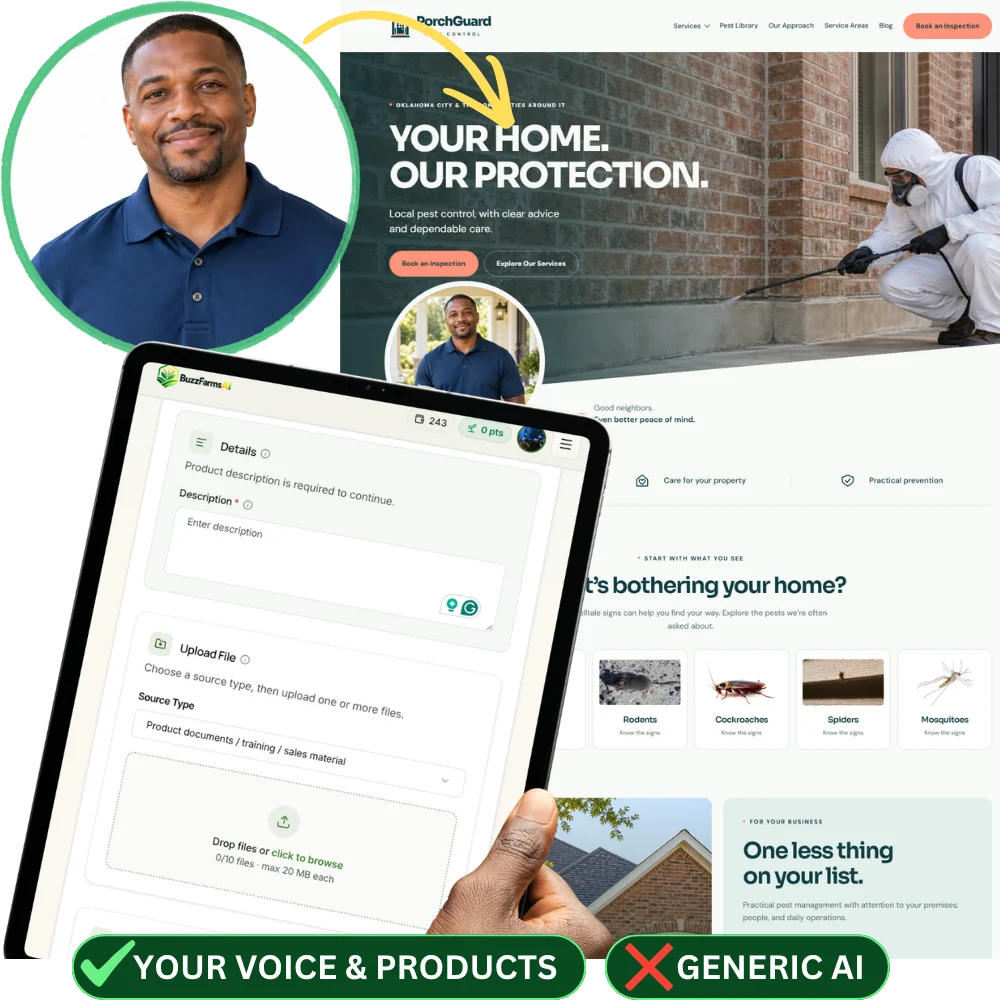
Begin with a real service brief
For a local property, the most important source is the business itself. Confirm what it does, which customers it serves, where it actually operates and how enquiries are handled. Use approved material rather than letting a template fill gaps with plausible details.
The seller describes ongoing content and opportunity research around this kind of Farm. That can support a more useful property than a page containing only a phone number, but automation does not know a business's current capacity or service boundaries unless accurate information is supplied and maintained.
For product fit before planning client work, read the broader BuzzFarmsAI buyer assessment.
An illustrative service-page brief
Imagine preparing a property for a garden-maintenance business. This is an illustrative workflow, not an actual client case study. The brief should make it possible for the business to approve every material service statement before it reaches a visitor.
| Brief item | Information to obtain |
|---|---|
| Services | The work actually offered, with important exclusions |
| Service area | Places the business genuinely serves, without invented branches |
| Availability | The approved way to describe scheduling and response expectations |
| Proof | Authorized photos, real credentials and any reviews with permission to use them |
| Enquiry path | The person or system that receives a request |
| Approval | Who signs off facts and later content changes |
Answer the service question
A visitor may need to understand whether a task falls within the service, what information to prepare or how the process works. Supporting content should answer those questions in the business's actual context. It should not manufacture a local identity by repeating the same text under a series of place names.
Distinguish useful location information from a claim that the business has an office there. Likewise, a generated image is not a photograph of completed work. Clearly identify illustrative material and keep the business's genuine evidence separate from promotional explanation.
For technical or safety-sensitive services, have a suitably knowledgeable person review advice before publication. A marketing-content feature does not establish the expertise needed to give instructions in a specialist trade.
Agree the enquiry handoff
Decide what the form or contact route is intended to collect and who is responsible for responding. Confirm the supported connection and test the approved handoff without using real customer information. A visible form is not proof that the right person will receive a request reliably.
Keep the requested information proportionate to the task and explain its intended use. A lead-generation concept does not automatically authorize selling, sharing or reusing someone's details. If a property is not operated by the service provider, the relationship and destination of enquiries should be clear to the visitor.
Before agreeing delivery and ongoing responsibilities, check client-work and licence boundaries.
Check quality before expansion
Treat a new Farm as a property to maintain, not an instant lead source. Review the accuracy of the service information, whether visitors can understand the next step and whether enquiries reach the agreed recipient. Confirm how the client reports usefulness or qualification rather than counting every submission as a valuable customer.
Expansion should follow a clearer understanding of the work. Add a service page because it answers a real question or represents a genuine offering, not because an agent can generate another page quickly. Local visibility and commercial results remain outcomes to observe, not entitlements supplied with a template.
For a more careful measurement framework, use Harvest metrics and lead definitions.
Questions answered
Does a local Farm guarantee leads?
No. A site and its marketing workflow can support discovery and enquiries, but demand, usefulness, distribution and the client's response all affect what happens.
Can I create pages for every nearby town?
Only publish location information you can support. Each page should serve a genuine reader need without inventing branches, service coverage or local evidence.
Can I sell the leads a Farm collects?
Do not infer permission from the product's lead-generation description. Establish the relationship, appropriate permissions and the intended handling of personal information before collecting or sharing it.
Keep the full picture
Connect this guide with the main review before choosing your workflow or package.
Read the main reviewSources and scope
Product descriptions are attributed to the seller; planning examples are editorial guidance, not measured outcomes.