
Compare the job, not the slogans
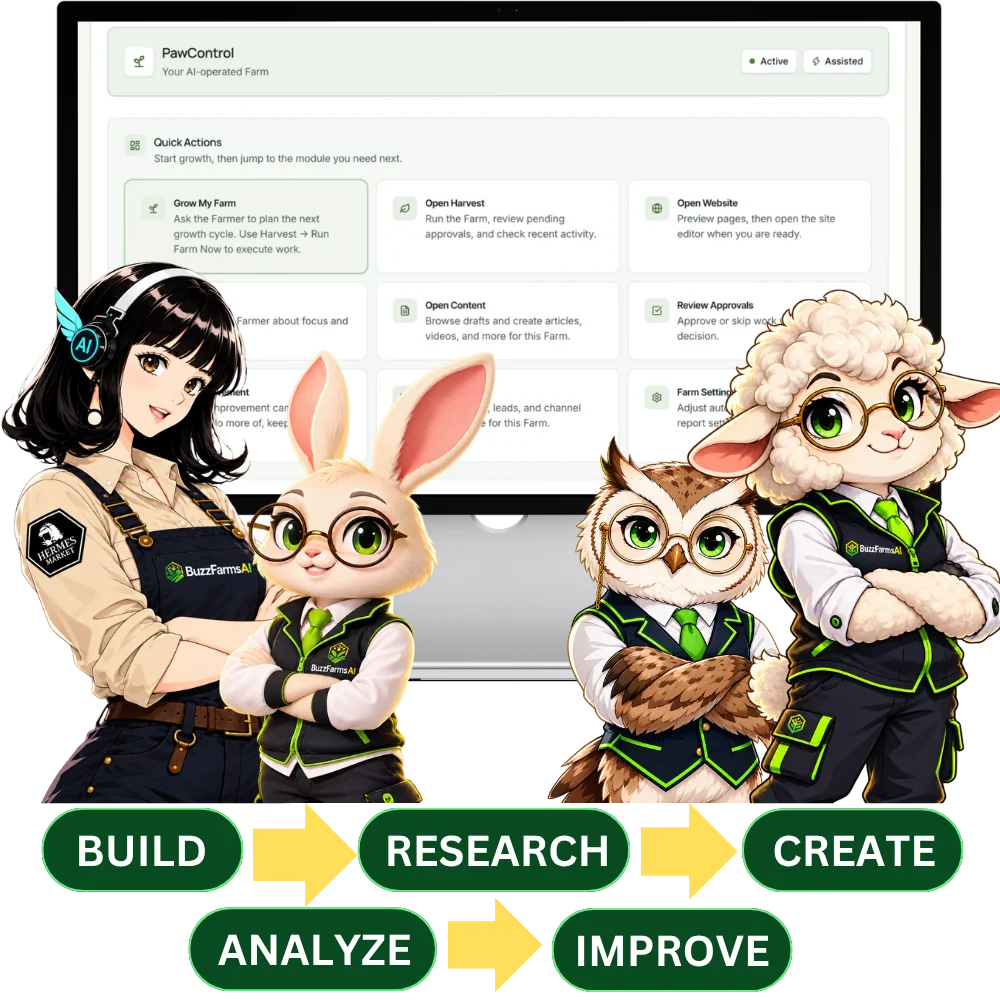
The seller's distinction is an ongoing Farm workflow rather than a collection of disconnected outputs. Its stated sequence connects the property, research, content, distribution and Harvest feedback. That may be attractive when maintaining those handoffs is itself the problem you are trying to solve.
A separately assembled stack can be sensible when you already have a reliable site and only need help with one task. Replacing everything to obtain a feature you could add separately may create unnecessary migration and learning work. Start by naming the gap rather than treating a new platform as the default answer.
For the main recommendation and audience fit, read our complete BuzzFarmsAI review.
A responsibility-based comparison
This table compares approaches, not measured performance or a verified winner among named competing products. The BuzzFarmsAI column summarizes the documented concept; exact tools, package inclusions and integrations still require confirmation.
| Task | BuzzFarmsAI Farm concept | Separately assembled approach |
|---|---|---|
| Site structure | Farm models and coordinated property creation | Choose a site platform and organize the property yourself |
| Content | Workers use the Farm goal and supplied knowledge | Carry the brief between your chosen content tools |
| Opportunity research | A worker investigates relevant audience activity | Research sources and assess opportunities with your own process |
| Distribution | Owned publishing and prepared contributions in the described workflow | Connect destinations and manage each tool's publishing scope |
| Feedback | Harvest signals inform the coordinator's next activity | Define events and reconcile data across your reporting tools |
| Oversight | Assisted workflow and an advertised Approval Center | Design and maintain the review checkpoints between tools |
When integration could be useful
Consider the Farm approach when repeated handoffs consume attention: the content writer lacks the current brief, the scheduler receives an outdated draft or the next article ignores what readers are asking. A shared goal and persistent context could make those relationships easier to manage.
The advantage should be tested against a real task. Ask how the workflow carries source information, what the reviewer sees and how recommendations become authorized activity. A demonstration of a coherent small assignment is more informative than a long list of possible business models.
To understand the coordination the product is promising, explore the Farmer Agent and Farm Hands model.
When keeping your stack makes sense
A DIY setup may fit an established workflow, a specialist requirement or a team with clear responsibilities already in place. You can select each component around a precise need. That flexibility still comes with work: maintaining connections, passing context correctly and deciding which system is the source of truth.
An open agent framework is also not identical to a finished marketing application. Building the surrounding property, integrations, review flow and reporting can require additional implementation. Compare the whole supported workflow you need, not just whether a framework can theoretically perform a similar task.
Use a short buying checklist
Write down what already works, which handoff is failing and the smallest change that would help. Then compare the learning, operating and migration work of each option. Do not count a promotional feature name as a confirmed entitlement or assume an integrated product removes every external cost.
- Can the approach handle the specific property and deliverable you need?
- Are the required destinations and data sources supported?
- Can you maintain the level of review the work requires?
- What becomes dependent on another account, service or subscription?
- What remains usable if you later choose a different system?
For the financial side of that decision, consult the BuzzFarmsAI pricing and package guide.
Questions answered
Is BuzzFarmsAI better than every separate AI tool?
That is not a defensible universal claim. The useful distinction is the coordinated Farm workflow; a specialist tool or an existing stack may suit a narrower requirement better.
Can I build a similar workflow myself?
A DIY approach can combine relevant components, but you remain responsible for implementation, connections, approvals and reporting. Compare that work with the actual supported product workflow.
Does one platform necessarily cost less?
Not necessarily. Confirm the exact offer, usage allowances and external dependencies, then compare the full cost of the tools and work you would actually use.
Keep the full picture
Connect this guide with the main review before choosing your workflow or package.
Read the main reviewSources and scope
Product descriptions are attributed to the seller; planning examples are editorial guidance, not measured outcomes.