
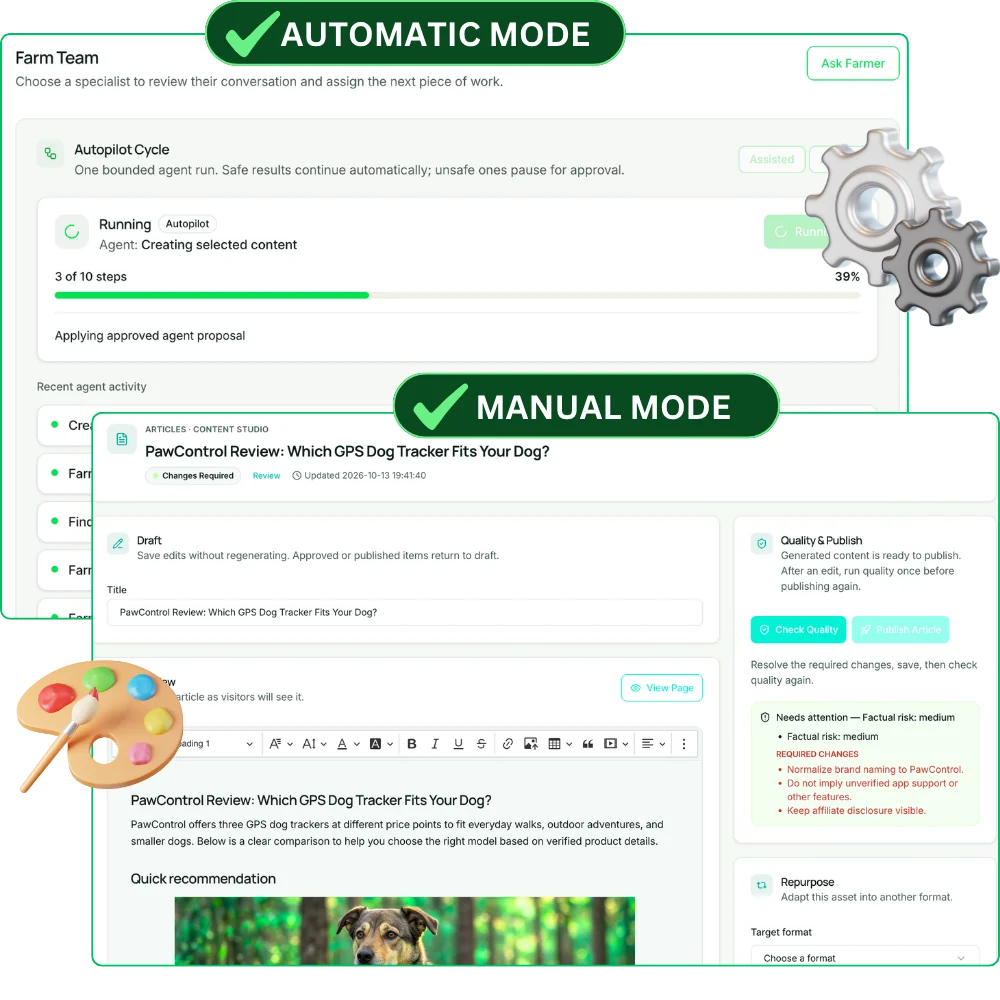
Preparation is not permission
A worker can research an opportunity, draft an article or propose a reply without being authorized to publish it. Keeping those stages separate makes an automated workflow easier to understand. The seller presents Assisted Mode as a way to review important activity, with more autonomous work depending on the permissions you provide.
The useful question is what a reviewer can see before approving: the actual content, destination, account and intended action. A general statement that AI will help grow a Farm is not a sufficiently specific instruction for contacting someone, changing a live page or posting in a community.
For the broader strengths, audience fit and limitations, read our full product assessment.
Write an approval boundary
The matrix below is an editorial planning aid, not a claim that these exact settings exist in the interface. Use it to decide what you are willing to authorize and what must return for review.
| Activity | Review before action | Reason |
|---|---|---|
| Research public sources | Check relevance and source quality | A discovered result can concern a different product or audience |
| Prepare an article | Read factual claims, links and supplied media | A fluent draft can still misrepresent an offer |
| Publish to an owned site | Confirm the exact page and approved revision | Ownership does not make every proposed change appropriate |
| Contribute to a community | Read the discussion and destination rules | Discovery does not supply posting permission |
| Change the Farm's direction | Inspect the evidence and proposed scope | A weak signal can lead to unnecessary expansion |
For the difference between finding a conversation and joining it, see traffic discovery and distribution boundaries.
Review inputs as well as outputs
BuzzFarmsAI describes using URLs, files and product knowledge in a Farm brief. Begin with approved public material where possible. A client's private records, credentials or customer information should not become a convenient source file without a clear need and appropriate permission.
Before connecting an account, confirm what the connection can read or change, who is allowed to use it and how access can be removed. Storage location, retention, encryption, audit history and credential handling require product-specific evidence. An Approval Center label does not establish those technical properties.
An illustrative publishing decision
Imagine a worker prepares a response to a gardening question and suggests linking a course. This is a hypothetical example, not an observed product run. A useful review asks whether the response actually answers the question, whether the linked resource is relevant and whether the community permits that kind of contribution.
The correct decision may be to improve the explanation, remove the link, use the research only on your own site or take no action. Approval should represent a considered decision, not a final click after a long queue of drafts. If the destination or purpose changes, revisit the approval rather than treating an earlier yes as unlimited permission.
Keep a manageable review loop
Start with a bounded task and a small set of destinations. Keep the agreed brief available, decide who checks changes and define when the workflow should stop for clarification. This makes it easier to notice when a worker carries an incorrect assumption into the next task.
Delegation is valuable when it reduces disconnected work while leaving responsibility clear. It does not transfer the publisher's responsibility for factual accuracy, permissions or the effect of external actions.
To understand the handoffs you are supervising, read how the Farmer and Farm Hands divide the work.
Questions answered
Does the Approval Center prove BuzzFarmsAI is secure?
No. It describes an oversight workflow. Technical security, data handling and access controls need their own product-specific evidence.
Can I leave every Farm action on automatic?
Do not assume every action is suitable for that treatment. Confirm available controls and keep sensitive, public or consequential changes subject to an appropriate review.
What should an approval include?
At minimum, understand the actual content or change, its destination, the account acting and the permitted scope. Revisit approval when those details materially change.
Keep the full picture
Connect this guide with the main review before choosing your workflow or package.
Read the main reviewSources and scope
Product descriptions are attributed to the seller; planning examples are editorial guidance, not measured outcomes.